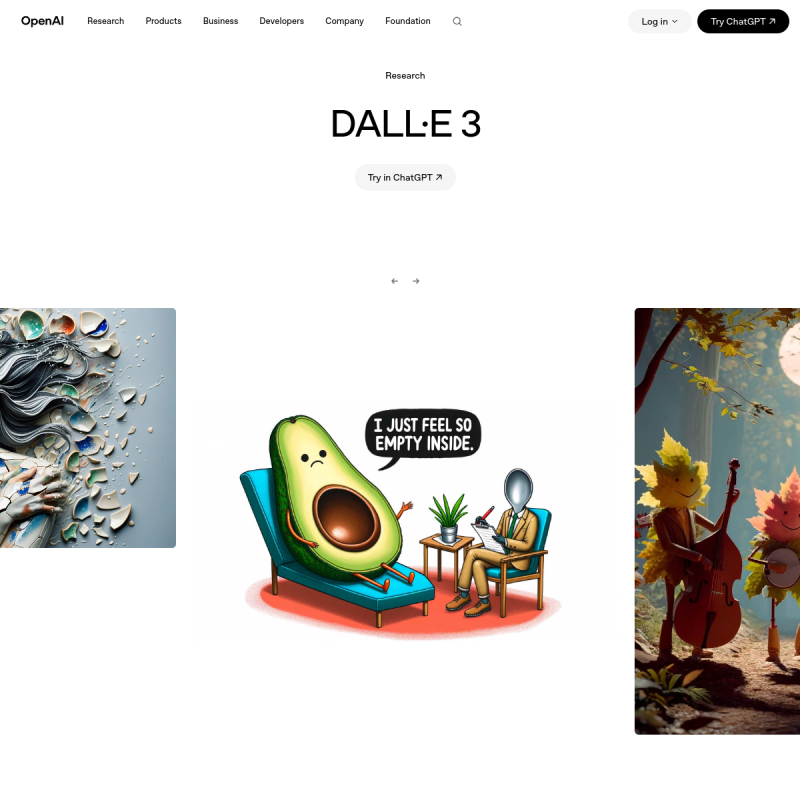
The generative AI market hit $44.89 billion in 2025, with AI-generated content becoming standard infrastructure rather than novelty. In this landscape, DALL-E 3's tight integration with ChatGPT isn't just convenient—it reflects how professional workflows now blend conversational AI with visual generation. The question isn't whether AI image tools matter; it's whether DALL-E 3's approach fits your production needs.
Real Advantages
Prompt adherence is where DALL-E 3 dominates. Unlike predecessors that required "secret menu" modifiers to get decent results, DALL-E 3 interprets natural language with impressive accuracy. Describe "a minimalist office with afternoon light streaming through blinds" and the output actually reflects that description. This reliability changes how you approach image generation—you spend less time iterating and more time producing.
The ChatGPT integration creates a genuine workflow advantage. When DALL-E 3 produces something close but not quite right, you can tell ChatGPT "make the background darker" or "change the color scheme to blue tones" and it understands context. This conversational refinement eliminates the frustration of starting from scratch with each iteration.
Commercial indemnification sets DALL-E 3 apart from competitors. OpenAI's terms grant you ownership of generated content and explicitly defend users against copyright claims. For businesses that can't afford IP liability questions, this protection is substantial. You're not just generating images—you're generating them with legal backing.
Text rendering finally works. DALL-E 2 struggled to put readable text in images; DALL-E 3 handles short phrases, labels, and signage with reasonable accuracy. It's not perfect for complex typography, but for simple headlines or product labels in marketing materials, it's functional. This opens use cases—mockups, social graphics, signage—that earlier models couldn't support.
Drawbacks
Brand consistency remains a challenge. If you're generating a campaign with 20 images, each one might have slightly different interpretations of "our brand's aesthetic." DALL-E 3 excels at individual images but struggles with the consistency that brand work demands. You'll need human review or post-processing for cohesive campaign assets.
Precise color matching isn't DALL-E 3's strength. "Generate this logo on a #2B7A78 background" might produce something closer to teal than your exact hex value. For work requiring brand-accurate colors, the output needs manual correction.
The "uncanny valley" effect appears in generated interfaces and technical diagrams. AI-generated UIs look almost right but contain subtle wrongnesses—misaligned elements, impossible shadows, inconsistent iconography. For quick prototyping it works; for polished deliverables, expect revision time.
Scientific accuracy varies. DALL-E 3 can produce misleading diagrams or technically incorrect visualizations. If you're generating educational content or technical illustrations, fact-checking isn't optional—it's essential.
Pricing Structure
ChatGPT Plus at $20/month is the most common access point. This includes unlimited DALL-E 3 generation (subject to rate limits), GPT-4 access, and full commercial usage rights. For individuals generating regular content, this is the obvious choice. The 100-image daily limit is generous for most use cases.
ChatGPT Team costs $25/user/month (minimum 2 users) with collaborative workspace features, admin controls, and usage analytics. The per-seat pricing makes sense for small agencies or creative teams that need coordinated AI access.
API access provides programmatic integration for developers building custom applications. Pricing varies by resolution: standard 1024x1024 images cost $0.040 each; HD quality or portrait/landscape orientations cost $0.080-0.120 per image. The API requires separate billing configuration but offers precise cost control for automated workflows.
Enterprise pricing is custom and negotiation-dependent. If you need dedicated capacity, compliance certifications, or data residency guarantees, you'll need to talk to OpenAI directly.
Use Cases That Fit
DALL-E 3 works well for marketing content, social media graphics, blog imagery, and initial concept exploration. The integration with ChatGPT makes it accessible to non-designers who need professional-looking visuals without learning complex prompting syntax.
Product mockups, storyboarding, and visual reference generation are strong fits. Content creators working on video projects use DALL-E 3 to visualize scenes before committing to production.
It's less suited for brand-consistent campaigns requiring exact colors and styles, technical illustrations needing precise accuracy, or high-volume content production where per-image costs matter.
Competitive Position
DALL-E 3 competes directly with Midjourney (more artistic, less precise) and Stable Diffusion (more customizable, less accessible). The ChatGPT integration gives it a workflow advantage for conversational refinement, while the commercial indemnification provides enterprise appeal. In the 2025 market, DALL-E 3 remains a top choice for professional content creators who prioritize reliability and legal safety over artistic extremes.